
What Is Universal Design?
Universal Design is the idea that homes should work for everyone — regardless of age, size, or physical ability — throughout their entire lifespan. Not just for someone recovering from surgery. Not just for a grandparent using a walker. For everyone, including the 35-year-old hauling ski gear through a narrow doorway.
The concept originated at the Center for Universal Design at North Carolina State University, where researchers developed seven guiding principles that are now used worldwide. Those principles — equitable use, flexibility, simplicity, perceptible information, error tolerance, low physical effort, and adequate space for approach and use — translate directly into how a home is designed, built, and remodeled.
The most important idea: function does not have to sacrifice beauty. A universally designed bathroom should look like a high-end renovation. You should notice the custom tile and the linear drain — not realize the curbless entry also eliminates a trip hazard. That invisible quality is what separates professional universal design from a clinical retrofit.
Learn more about the 7 Principles →
By the Numbers
The U.S. Census Bureau projects :
-
77 million people will be aged 65 +by 2034.
-
81.5 million Americans aged 45–64 are already have aging-related health conditions.
-
According to AARP, 75% of seniors prefer their home to assisted living facilities
-
20% of Americans are living with a disability
This doesn't even include people recovering from injuries, families with newborns, Multi-generational households — all who could benefit from their home accommodating those changes.
Universal Design addresses these unique concerns.
Becoming a certified universal design remodeler was a choice in line with why I started this business in the first place - to meet the needs of everyday people.
Why the UDCP Certification Matters
Most contractors can install a grab bar. A NARI Universal Design Certified Professional understands the full picture — the anthropometrics behind reach ranges, the spatial clearances that make a wheelchair turn possible, the construction techniques that put structural reinforcement behind the walls before it's needed, and the material science behind surfaces that withstand mobility aids without looking institutional.
The UDCP certification covers seven domains: universal design fundamentals, client needs assessment, design standards (NKBA and ICC/ANSI 117.1), construction techniques, electrical systems, plumbing and mechanical systems, and exterior considerations. It's the only NARI certification focused entirely on accessibility.
What that means in practice: I don't just install accessible fixtures. I design spaces around published clearance standards, I specify products rated for the loads they'll actually bear, and I build the hidden infrastructure — blocking, wiring, drain placement — so your home can adapt as your needs change, without tearing open finished walls.
What We Build
Curbless Showers
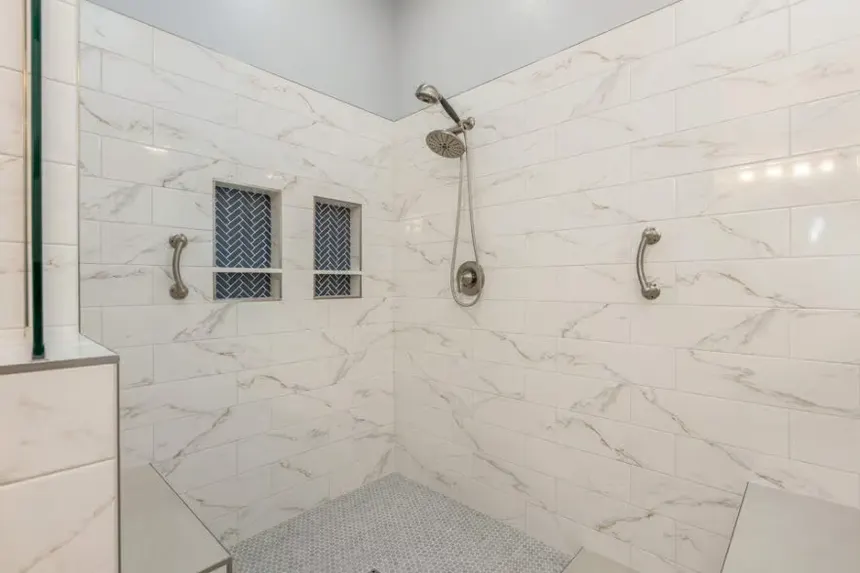
We specialize in full-gut bathroom renovations that eliminate the shower curb entirely. The shower floor is recessed into the framing and sloped toward a linear drain, creating a seamless transition from bathroom floor to shower. Grab bars are secured to structural blocking and rated for real-world loads. Seating, handheld shower sprays on adjustable slide bars, and thermostatic anti-scald valves are standard.
The details matter here. We install plywood backing behind the finished wall surface so grab bars can be added at any position — now or years from now — without demolition. If a client isn't ready for visible safety bars today, the structure is already waiting.
Read more: What makes a UDCP bathroom different →
Kitchens That Work for Everyone
Kitchens see the most physical interaction of any room in the house. We design them with multiple counter heights, elevated dishwashers, front-control cooktops, and pull-out storage — all following NKBA planning guidelines. The goal is a kitchen that a seated user, a standing adult, and a child can all use comfortably, without the space feeling like it was designed for a specific disability.
Read more: Universal design kitchen features →
Doorways, Flooring & Transitions
We widen doorways to 36 inches with custom trim work so the wider opening looks like an intentional part of your home's architecture. Floor transitions are held to a maximum ½-inch height difference, using materials chosen for both durability and slip resistance.
Zero-Step Entries
We design entries that eliminate steps and blend into the landscape — whether that's regrading a front walkway, building an integrated ramp, or converting a garage entry into the primary accessible entrance. Exterior lighting, covered entries, package shelves, and keyless entry are part of the package.
Read more: Ramps, thresholds, and exterior access →
Electrical & Lighting
Small changes to switch and outlet placement have outsized impact on daily usability. We mount switches lower, outlets higher, and specify layered lighting with dimmable controls — including voice-activated options where appropriate. These are changes that benefit every household member, not just someone with a mobility limitation.
Who Benefits
Aging in place — the largest market, and the one most people think of first.
People with disabilities — homes that were never designed for a wheelchair, walker, or visual impairment.
Multi-generational households — the sandwich generation, with aging parents and young children under one roof.
Temporary recovery — anyone coming home from surgery, injury, or illness.
Families with young children — lever handles, lower switches, raised outlets, and slip-resistant flooring are safer for kids too.
The Bozeman Context
Bozeman's housing stock — from historic Willson Avenue ranches to newer builds in the Northwest — was overwhelmingly built without accessibility in mind. A well-planned universal design remodel costs a fraction of a single year in assisted living and increases resale value, because these features appeal to buyers of all generations.
The Tax Angle Most People Miss
Many aging-in-place modifications — including curbless showers and widened doorways — may qualify as itemized medical deductions if prescribed by a healthcare provider. Heartwood Craft provides detailed, itemized invoices to assist with the documentation you'll need at tax time.
Our Process
Every project starts with an Environmental Assessment — a structured room-by-room survey of your home covering entry access, doorway widths, threshold heights, fixture clearances, electrical placement, flooring conditions, lighting, and grab bar locations. We identify both immediate needs and future needs, so we can build the infrastructure now even if the visible hardware comes later.
From there, we use 3D modeling to show you exactly how the finished space will look before we pull a permit. You can see how the grab bar placement integrates with your tile pattern and how the wider doorways affect your hallway proportions.
We scope and price every job up front. No surprises.
[Button: Start Your Project Plan]
Learn More
Universal design covers a lot of ground. These posts go deeper on specific topics: